




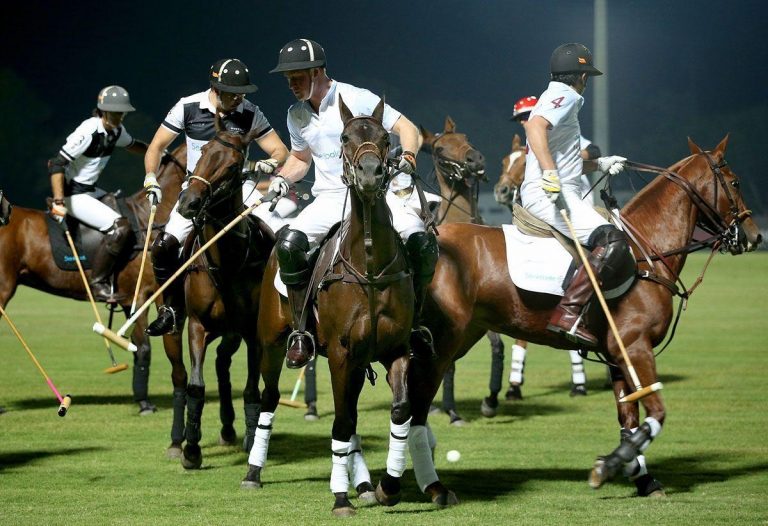
It is a rare sport that can attract the wealthiest of the wealthy, the most glamorous in town and royalty all at the same time. And it is even rarer that patrons are willing to forego sometimes millions of dollars purely to enjoy the game. That is the state of polo – particularly in the UAE.
The elitist sport has matured in Dubai and Abu Dhabi at the fastest rate in polo’s history, with the former beckoning to match Argentina and the UK as a global polo capital within a few years. Its growth has been in line with the country’s economic rise, fuelled by millionaire businessmen and amateur and professional players with deep pockets, as well as luxury brand sponsors keen to expose themselves to high net worth individuals (HNWIs).
There are now two internationally certified polo competitions in Dubai and one in Abu Dhabi, as well as British Polo Day (held in both emirates) and Beach Polo Cup Dubai, both of which were created in Dubai and have expanded worldwide.
Britain’s Prince Harry, a keen polo player, also last year chose Abu Dhabi to hold his annual charity polo match, raising more than $1.5m, and many of the world’s best players have joined UAE-based teams.
But while popular events are starting to break even, the idea of profits in the notoriously expensive sport so far has been “impossible”, says one of the UAE’s largest financial backers of polo, businessman Mohammed Al Habtoor.
Al Habtoor forks out almost $1m a year just to maintain his 35 polo ponies, on top of any cost overruns at his events and the six- or seven-figure salaries he pays top players to play in the UAE.
It is similar to feeding an addiction, he says.
“As a patron you don’t make money, it’s all about a hobby. It’s an expensive hobby but once you have your team and you play, whether or not you win or lose, it’s a game you get really addicted to,” Al Habtoor says.
He is hoping the new $270m Al Habtoor Polo Resort & Club, including a five-star hotel with 136 rooms and 162 bungalows, a polo club, a polo academy, a riding school, 500 stables and three professional polo fields, will finally turn the sport into a money-making venture.
Al Habtoor says demand is so great he already has verbal agreements to lease the majority of the stables, which will also support other equestrian sports in the UAE.
Meanwhile, British Polo Day Dubai (BPD) and Beach Polo Cup Dubai (BPCD) are both rapidly expanding worldwide, not only creating successful businesses but broadening the emirate’s mark as a major influence in the sport.
BPD, a parallel exclusive VIP event on one side of the polo field and an open-door, casual picnic on the other side, is now run in ten cities across India, China, the US, Australia, Mexico, Morocco, Russia and the UAE, with plans for Brazil, South Africa and South Korea to be added in 2016/17.
British corporate lawyer and co-founder Tom Hudson says the event started in 2009 with a minimalist approach due to the game’s expense but it has grown to attract more international CEOs and chairmen each year, including Sir Richard Branson in Morocco and Elon Musk in the US.
“I didn’t have the money personally to fund it, so we’ve had to create a business model that’s viable through some amazing partnerships,” he says. “I genuinely think we’ve done something a bit new and innovative in the world of polo.”
This year, 450 VIPs and up to another 2,000 picnickers are expected to attend BPD in Dubai, and more than 10,000 at all of the events.
Beach Polo Cup Dubai was the world’s first polo game on sand and pioneered the concept of a smaller field, creating a more intimate spectator experience.
The idea, launched in Dubai in 2005, was later copied in multiple cities around the world.
“It was just a fun idea, we didn’t have any business plans,” founder Sam Katiela says. “Suddenly it grew tremendously.
“We started taking it seriously from the business point of view two years ago.”
Katiela is preparing to launch Beach Polo Cup Dubai in Nigeria, South Africa and Spain in the next two years in a bid to recapture kudos for creating the concept.
Rather than hoping for a money-maker, he is using the April event to showcase his creative solutions business, Mamemo Productions, while it also serves as a major networking opportunity. Katiela says he, sponsors and invited guests including Bombardier, Land Rover and, previously, Jaeger-LeCoultre have made several business leads and later secured new contracts based on the success of the event and networking during the weekend.
“We don’t make money out of it, but with it,” he says. “[Last year], I generated really good business out of it because clients were impressed.
“It’s more to present ourselves and international brands. We [also] want to reflect that we’re ready to host international, high-class events,” Katiela adds, referring to the 2020 World Expo in Dubai.
Katiela is concerned foreign firms will automatically be hired to run the World Expo and hopes the organisers of superior events such as those for polo can showcase local firms’ talents and lead to them being selected when the government calls for tenders.
Meanwhile, polo events are also attracting an increasing number of visitors who spend money on hotels and other activities, contributing further to the UAE economy.
Katiela says 12 billionaires attended the Beach Polo Cup in Dubai last year, while Hudson says the UAE’s growing reputation and central location have seen many wealthy enthusiasts fly in specifically for British Polo Day and other equestrian events.
Polo has been played at a relatively high level in the UAE since the early 1990s, when Ali Albwardy — now affectionately referred to as ‘the father of polo in Dubai’ — established the Desert Palm Polo Club. It was followed by the private Ghantoot Racing & Polo Club in Abu Dhabi, launched by the late President of the UAE, His Highness Sheikh Zayed Bin Sultan Al Nahyan, and then Emaar chairman Mohamed Alabbar’s Dubai Polo & Equestrian Club in 2005.
Those fields saw Emirati royals engage in the game, adding impetus.
But it has been only the start of events drawing in professional players and luxury brand sponsors in recent years that has seen it flourish.
The recruitment of Argentinian star Adolfo Cambiaso, ranked number one in the world, to Albwardy’s team, helped the emirate launch onto what is called the ‘high goal scene’ — the elite level of the sport.
Now, ten teams compete at the Dubai Polo Gold and Silver Cups — both part of the official World Polo Tour. That compares to 14 at premier competitions in the UK, where polo has been played for more than a century, and six at the US Open Championship at Palm Beach, which also has been running for decades.
Al Habtoor says he was motivated to throw excessive amounts of money behind the polo cup events to help elevate his own enjoyment of the game.
“Six years ago playing polo in Dubai was not very interesting,” he says. “I played with the same people every day for years, so my polo didn’t really improve and the only idea I had to improve my polo was spending a little money to get more horses. This way I can fly some professional players from the UK and Argentina to come and play, who are five, six, times better than us.”
It is an expensive exercise, with sponsorship barely covering 30 percent of the event’s $550,000 annual costs in the first three years. However, gradual growth in sponsorship has made the event break even.
“To make a profit from the sponsorship would be impossible because every year the costs are getting higher,” Al Habtoor says. “My aim is to cover my costs.”
Part of that aim will include moving the event to the Al Habtoor Polo Resort & Club when it opens next year, taking with it the revenue generated from food and beverage sales during the event, as well as the expected hotel bookings.
It is the huge amounts of money surrounding polo that attracts its sponsors — typically exclusive brands targeting HNWIs, who are the most likely to participate and watch the sport.
Swiss private banking group Julius Baer, which has previously sponsored the Beach Polo Cup Dubai and this year will be the headline sponsor of the Dubai Polo Gold Cup, says the sport makes ideal brand positioning for the bank, with the UAE being one of its most important growth markets.
“It highlights our dedication to supporting an activity that is highly valued by our target audience of HNW and UHNW individuals who we know appreciate the dynamics of the game, and this in turn provides us a great platform to engage them,” Daniel Savary, Julius Baer’s head of Eastern Mediterranean, Middle East and Africa (EMMEA), says.
Other sponsors, such as Swiss luxury watch and clock manufacturer Jaeger-LeCoultre (J-LC), have had a relationship with polo decades before it grew in the UAE. The wealthy Gulf state was an obvious sponsorship extension.
“One of our famous watches, the Reverso, was invented in 1931 because British colonial army officers in India who were playing polo were breaking the glass during the games,” J-LC Middle East brand director Marc de Panafieu says. “They asked [J-LC to create] a watch that could sustain the shocks during the polo game.
“One of our most successful [product] lines is the game of polo — that goes back to the Reverso.”
J-LC’s new sponsorship of the British Polo Day now gives it exposure to HNWIs across the globe, particularly in emerging markets such as China, where the sport is taking off amongst billionaires.
Luxury men’s clothing brand Hackett also has had partnerships with polo globally for three decades and has supported the British Polo Day since it launched in the UAE five years ago.
“Polo has been a complete success for the brand since we first became associated with the sport in 1985, just two years after Hackett’s inception,” Neil Bugler, the company’s global sponsorship manager, says. “Polo sponsorship still plays a vital role in the brand’s DNA.”
Bugler says the return on sponsorship investment in the UAE is “decent” but limited due to the “notoriously slight” television coverage.
Hudson, who created BPD with the backing of Al Habtoor, says the sports elitism is its greatest asset in attracting wealthy investors and high-end sponsors to fund it, but can also be its largest downfall in turning off some.
“Unlike things like football where there’s 50,000 watching, only the top matches [of polo] have huge turnouts, so I’d say for the most part, anyone running a polo team or polo event are just trying to cover their costs as best they can with sponsorship,” he says. “We decided that any profit we make on the events to date we’ve reinvested into the event to build a platform.
“Polo as the ‘game of kings’ has always been associated with the very wealthy; not least as they are the ones that can afford it, but the successful businessmen usually have a thrill- or risk-seeking side and polo provides a nice outlet.”
However, the historically inaccessible sport has become a little more accessible through the Dubai Polo Academy, which launched in 2005 to offer tuition to both Dubai residents and visitors.
“Dubai is one of the most aspirational destinations in the world, therefore, it made perfect sense that it should also offer a facility to learn one of the most aspirational sports in the world,” founder Steve Thompson says.
“Having been in the industry for nearly 25 years I knew that if the concept failed within the local community it could still survive with in-bound clients coming to Dubai purely for a ‘learn to play’ polo vacation.”
Those holiday “boot camps” now make up a significant proportion of the academy’s revenues, while corporate days also have become popular as an incentive or reward at high-end companies.
The academy has been operating at full capacity almost permanently since opening with ten horses and it now has a waiting list at the beginning of playing seasons. Revenues have grown at an average 12 percent a year.
“The big polo dynasties such as the Bin Drais, Al Habtoors, Albwardys and the other Abu Dhabi players have been massively instrumental in the growth of the sport in the region,” Thompson says. “Their ongoing support will ensure that Dubai really will be up there and recognised as one of the top five polo playing destinations in the world, on a par with England, Argentina and the US.”
In a country used to putting money where its mouth is, there seems little reason to doubt such bold aspirations.
Follow us on

